Before the transformers are shipped to customers, they are thoroughly tested to ensure that they meet our internal quality standards, customer requirements, and industry-standard regulations. This way, the customer can be confident that they are receiving a reliable product.
Our colleague Stefan Voeten works in our High-Voltage Lab. What does Stefan do on a day-to-day basis?
Transformer Checks; Factory Acceptance Test
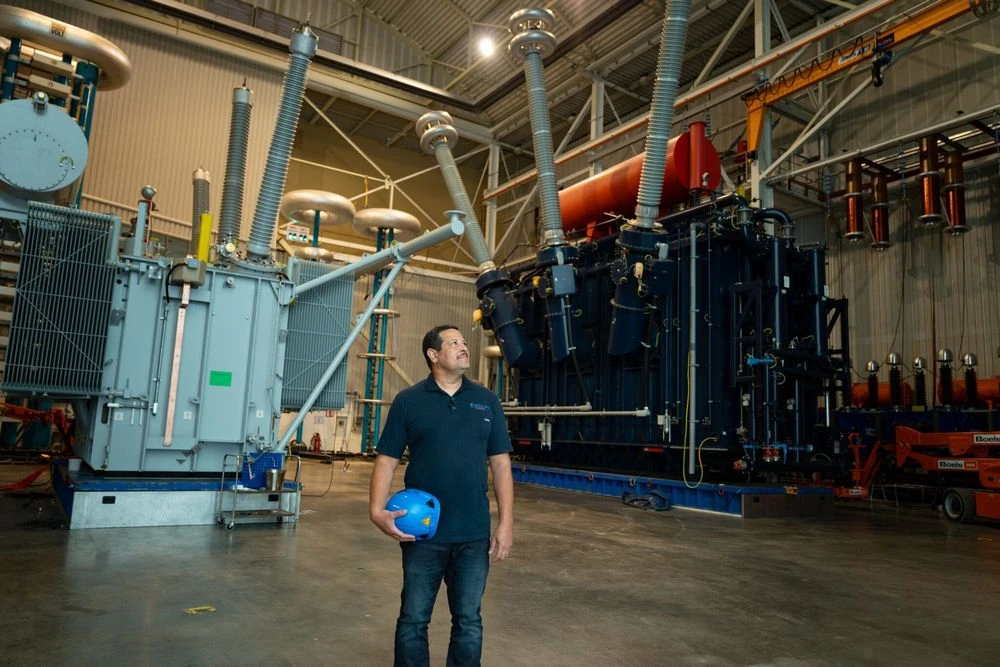
“At Royal SMIT, we manufacture transformers on an ‘engineered-to-order’ basis. Every transformer, or small series of transformers, is designed specifically for the customer. This requires a strong focus on quality. In addition to the various Quality Check Points (QCP) during the production process, there is a Factory Acceptance Test (FAT) conducted in the high-voltage lab at the end of the process. During the FAT, we verify that the transformer meets all specified requirements.”
In the high-voltage lab, various tests are performed on each transformer.
Losses
Transformers are very efficient. However, losses do occur here as well. This is energy that the grid operator can no longer sell to customers, resulting directly in a financial loss for the grid operator. That is why customers set requirements for the maximum losses allowed in the transformer. In the high-voltage lab, the losses in the transformer are measured, recorded, and reported to our clients.
Sound
The magnetic fields in the transformer cause vibrations and noise. This noise is measured to verify that it remains below the guaranteed threshold. Noise is a particularly important consideration for transformers used near residential areas.
Cooling
The losses in the transformer are primarily converted into heat. To verify that the transformer’s cooling system is functioning properly and that the transformer does not overheat, it undergoes a “heating test.” This test measures how hot the transformer becomes. It is important that the temperature does not get too high, otherwise it will shorten the transformer’s service life.
Dielectric Testing
The voltages in the transformer are very high. To prevent short circuits in the transformer, great care is taken with the electrical insulation inside the transformer.
Transformers are insulated on the inside with cardboard, paper, and oil. This insulation is tested in various ways; lightning strikes and large switching pulses that can occur in the high-voltage grid are applied directly to the transformer’s terminals.
To ensure that the insulation is in good condition after all the tests, the transformer is set to 158% of the normal voltage for one hour at the end of the process. Any irregularities, faults, or damage in the insulation will cause high-frequency signals in the voltage during this hour. If these high-frequency signals remain below the guaranteed value, the transformer is “Fit For Service!”
Oil Analysis
Between tests, oil samples are taken from the transformer. These are analyzed in the oil lab. If there are faults in the transformer, hydrogen gas or hydrocarbon gases may be produced. These dissolve in the oil and can be detected even at low concentrations. If something is wrong with the transformer, it will show up in the oil.
Ready, set, go!
Once the above-mentioned tests have been completed and the customer has approved everything, we know we have built a high-quality transformer. The transformer can then be prepared for shipment to the customer and is moved to the “shipping-ready” hall. Here, all components—such as radiators and piping—are removed from the transformer and placed on pallets. A final “fingerprint” measurement is taken at this stage. Once the transformer arrives on site, the “fingerprint” measurement is repeated. If these measurements are identical, nothing has changed during transport, and the transformer can be assembled. After the transformer is assembled, a number of additional verification measurements are performed, and once these are also confirmed to be correct, the customer has a reliable transformer!

Stefan Voeten
Test Expert at the High-Voltage Laboratory