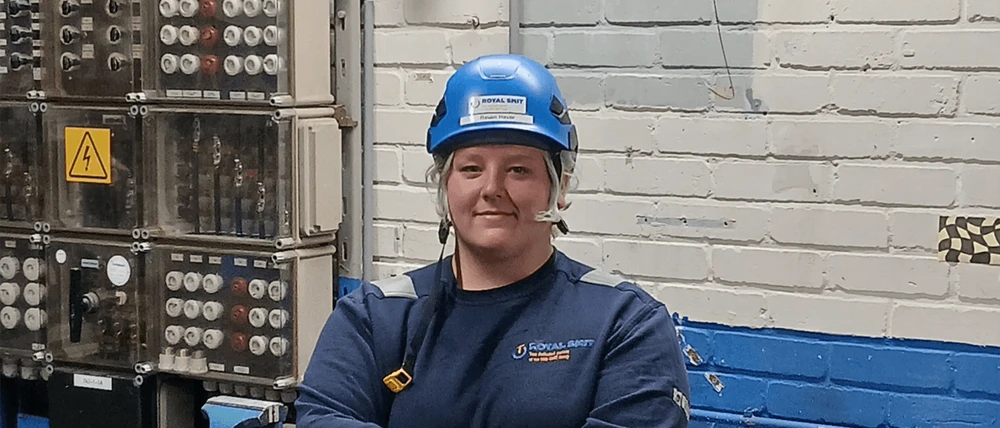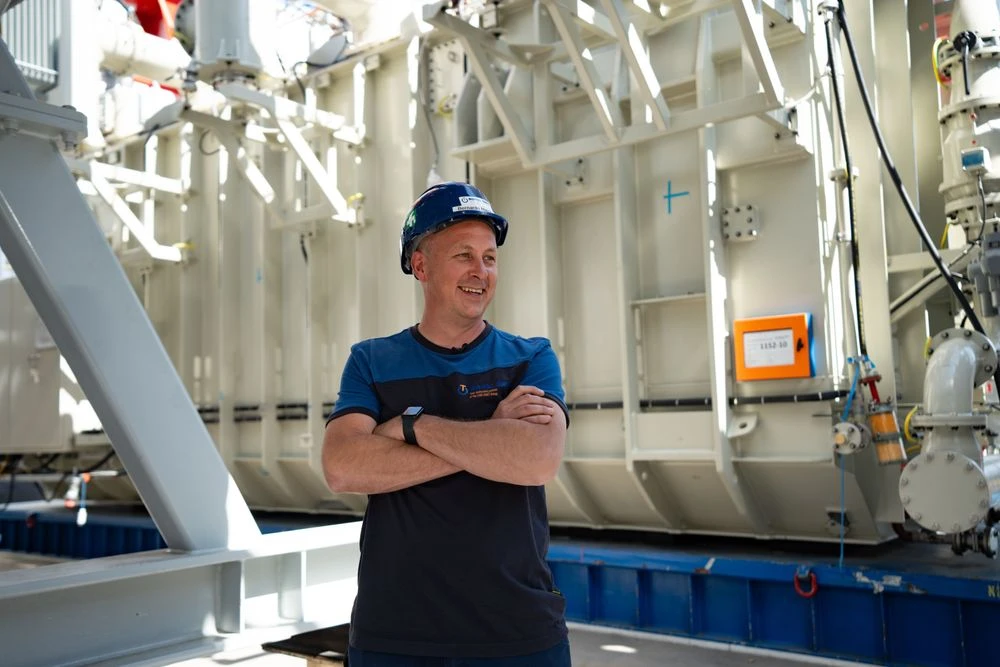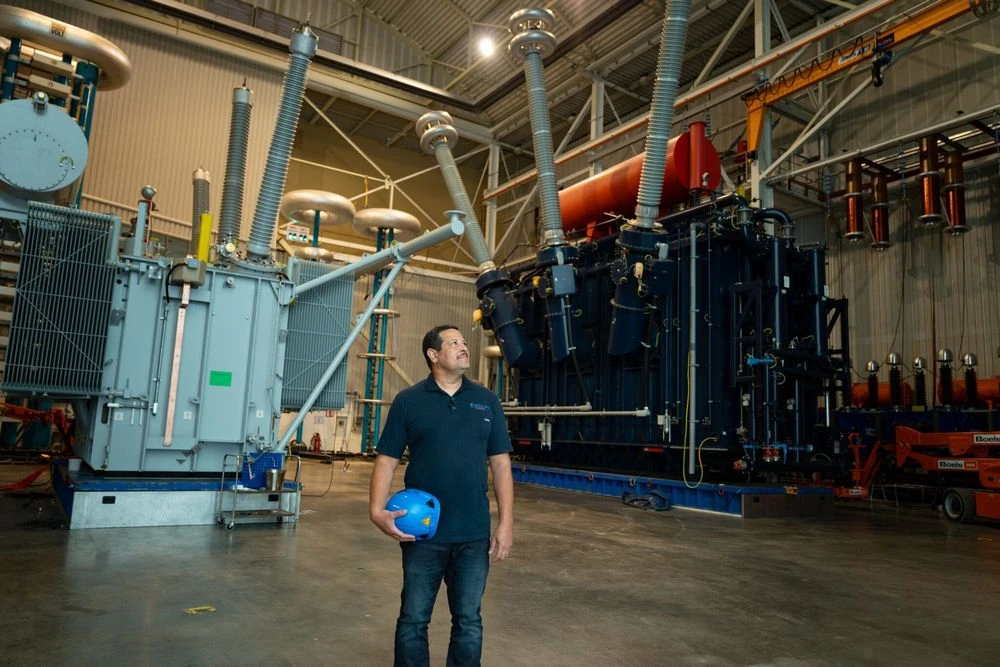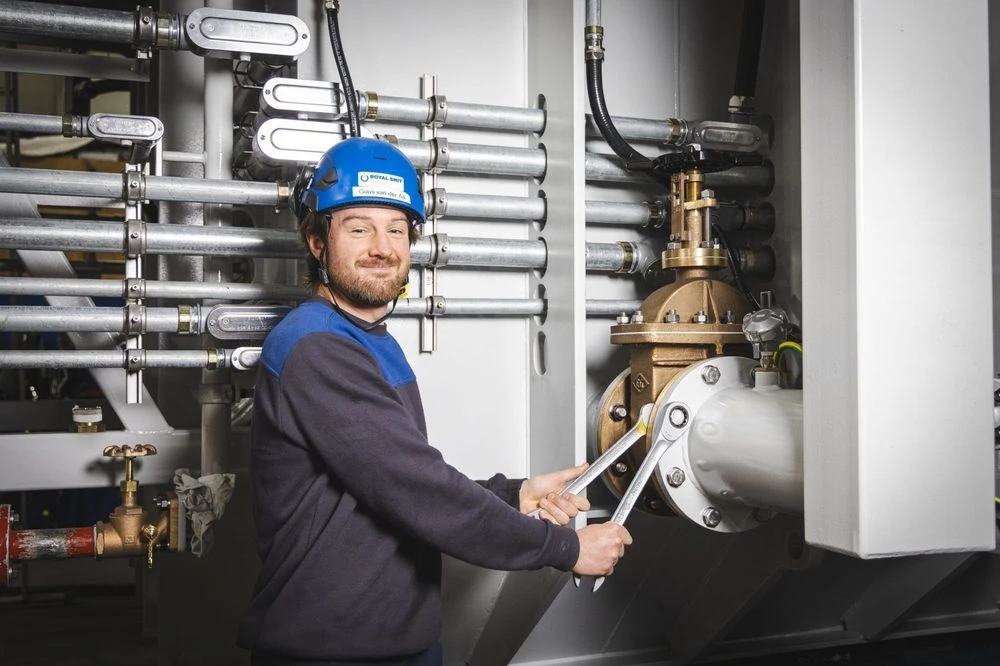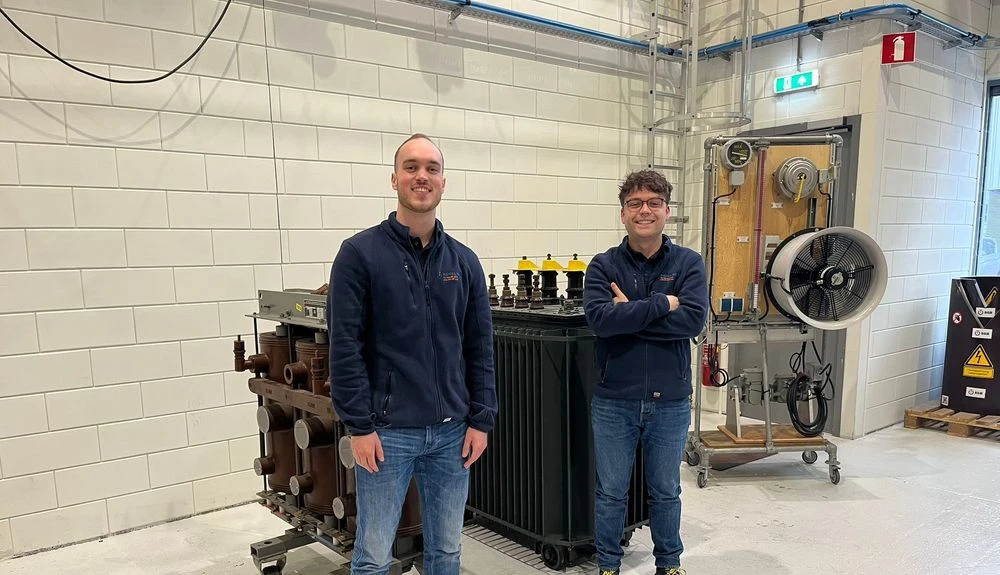
Anyone walking through the Royal SMIT Transformers factory will see craftsmanship in action. Hands that have known what they’re doing for years, knowledge that has sometimes been passed down through generations—but how do you ensure that this knowledge doesn’t just remain in people’s heads and hands, but also becomes accessible to new colleagues? That question lies at the heart of the work of Abe ten Brinck and Ruben Ottens, L&D specialists at Royal SMIT. Together, they developed a comprehensive training curriculum for the internal assembly department—and they’re doing it not from behind a desk, but right in the thick of the action.
Let me introduce myself
Abe has been working at Royal SMIT as a Learning & Development specialist for about eight months now. “In practice, this means that I work with Ruben to develop training programs for production,” he explains. “We’re constantly building and improving learning pathways.”
Ruben has been working at Royal SMIT for almost two years now. "I graduated here and then decided to stick around," he says with a smile. "I was given the opportunity to actually implement the advice I gave during my graduation project. That was the reason I decided to stay."
What connects them? A passion for learning and for the people who practice the profession every day.
Why Royal SMIT?
For Ruben, the choice was logical. “Royal SMIT is close by, which was important. But what makes it extra special is that my father and grandfather also worked here. Three generations at the same company—that says something.”
Abe joined the company through a different path. “During my studies, I heard a lot of great things about Royal SMIT—about the atmosphere, the culture, and the opportunities. That turned out to be completely true when I came here for an interview. I got to experience those things for myself.”
Both immediately cite safety, the family-like atmosphere, and craftsmanship as key reasons for working here. “You can tell this is a place where people are proud of what they make,” says Ruben.
Proud to work together
What are they most proud of together? The answer is clear: the training program for interior assembly.
“What we’ve achieved there together is truly something special,” says Abe. “We worked together with the people on the shop floor, as well as with the quality, engineering, and HSE departments. All that expertise came together.”
Ruben adds: “We’ve been able to connect departments, and everyone has learned something in the process. In this way, we hope to ensure that we’ve made a lasting contribution to better collaboration between these departments. The great thing is that you can see how enthusiastic our colleagues in production are about the results. That enthusiasm—that’s what I’m proud of. I’m also proud of the on-the-job trainers, known as mentors. They’ve worked incredibly hard on this program. They’ve gone above and beyond for their colleagues, and I think that’s characteristic of Smit.”
“The program isn’t just a set of instructions. It’s a way to preserve knowledge, pass it on, and prepare it for the next generation. We’re organizing knowledge that has been here for a long time so that new colleagues can make use of it more easily,” says Abe.
Feedback from practice
How has the program been received on the job? “Very well,” says Ruben. “It takes time and energy—people sometimes forget that—but we’ve heard back that it’s easy to follow, works well, and helps with day-to-day work. In the interior assembly department, 80 colleagues have completed the curriculum, and everyone provided us with feedback—that was really great.”
At the same time, it remains a living, breathing whole. “We’re constantly listening,” Abe emphasizes. “Sometimes we get criticism, but that’s actually a good thing. This is the first time we’re implementing this in this way, so we’ll keep adjusting and improving.”
Learning doesn't stop at one department
The training program for interior assembly is just the beginning. “The goal is to build a training curriculum for every position within Royal SMIT,” Ruben explains. “We started with Operations, but engineering and other departments will follow.”
“We’ve been building transformers for a very long time,” says Abe. “That knowledge is stored in people’s minds.” How do you ensure it’s preserved properly? “That’s complicated, but it’s also a challenge we’re happy to take on.”
What makes this program so special?
According to Abe, the power lies in the details. “It often comes down to very specific knowledge. By talking to colleagues and asking, ‘How do you do this safely, and how do you ensure quality?’ we make that clear. For new colleagues and for ourselves, but also for our current colleagues—it’s helpful for them, too.”
Ruben focuses primarily on the human aspect. “We make sure that new colleagues feel at home more quickly. And at the same time, we empower experienced colleagues. They take on a coaching role, in which they focus not only on the product, but also on the person in front of them.”
That appreciation is palpable. “We often tell people, ‘You have so much knowledge,’” Abe says. “They don’t hear that every day, but it’s true. By acknowledging that, you see your colleagues grow.”
Contribution to the energy transition
Well-trained professionals are indispensable for the future of energy. "You need a tremendous amount of knowledge to operate a transformer properly," says Ruben. "A training curriculum helps new colleagues quickly acquire that knowledge and feel confident on the job."
“In addition, something new emerges: colleagues learn from one another—not only in terms of subject matter, but also in terms of teaching methods: how do you effectively convey information? In this way, the program indirectly contributes to better products, higher quality, and a future-proof organization.”
Three weeks of assisting with the assembly
To make the program truly hands-on, Abe and Ruben literally went out onto the shop floor. “We spent three weeks working alongside the interior assembly team,” Ruben explains. “We put on our work clothes, jumped right in, and experienced what the job is really like.”
Then the real digging began. "We mapped out all the activities," says Ruben. "From safety to quality requirements, from collaboration to specific skills."
“An important principle: the front-line staff take the lead. They’re the ones who have to work with it,” Abe emphasizes, “we’re here to facilitate. It needs to help them with their daily challenges, and it has to be practical.”
A great employer
What do they think makes Royal SMIT a great place to work? “The informal atmosphere,” says Ruben. “You can talk to anyone and walk into any office. That makes it easy to switch gears.”
Abe nods. "That culture encourages you to ask questions quickly and move forward together."
Advice to new colleagues
Their advice is clear and down-to-earth. “Come and experience it for yourself,” says Ruben. “Especially in the operating room, you’ll learn a skill here that you can’t learn anywhere else.”
Abe adds: “It’s a unique craft. It takes time to master, but that’s exactly what makes it special. And right in the heart of Nijmegen!”
Learning and development as a calling
For Abe, L&D was a conscious choice early on. "During my studies, I already knew that this was what I wanted to do. The field is so broad, which really appealed to me."
Within the project, he mainly played a connecting role. "Lots of contact with mentors, building the digital learning platform, making sure everything comes together."
What he learns here, he cannot learn anywhere else. "Communicating with so many different disciplines, switching gears quickly, understanding each other's worlds."
His "typical Smitter" trait? "Genuine interest in others. Ask how someone's weekend was. Without interest, you won't get anywhere."
Growing with the team
Ruben has witnessed L&D’s growth firsthand. “When I started, there were four of us. Now there are eight of us, and we have a new training center, an LMS, in-house trainers, mentors, and skill matrices. The difference is enormous.”
That pioneering phase brings challenges with it. "Not everyone was immediately enthusiastic," he says honestly. "We've been doing this work this way for a hundred years. So change is exciting."
The moment when everything came together? “When all the colleagues from the interior assembly team—about 80 people—had gone through the program and we received their feedback.” That’s when I thought, “Yes, this is really making an impact.”
Building the Future Together
Ruben describes the atmosphere within L&D as open and driven. "We are working towards a vision of the future. We make mistakes, learn from them, and keep moving forward."
What about switching jobs? “Maybe I’d like to spend a day observing the engineering department,” he says with a laugh. “But honestly? I’m happy here.”
“What we do here is about people,” Abe summarizes. “It’s about sharing knowledge, showing appreciation, and building the future of Royal SMIT together.”
And that is precisely what makes this training program so much more than just a learning process.